Databasin vs Fivetran
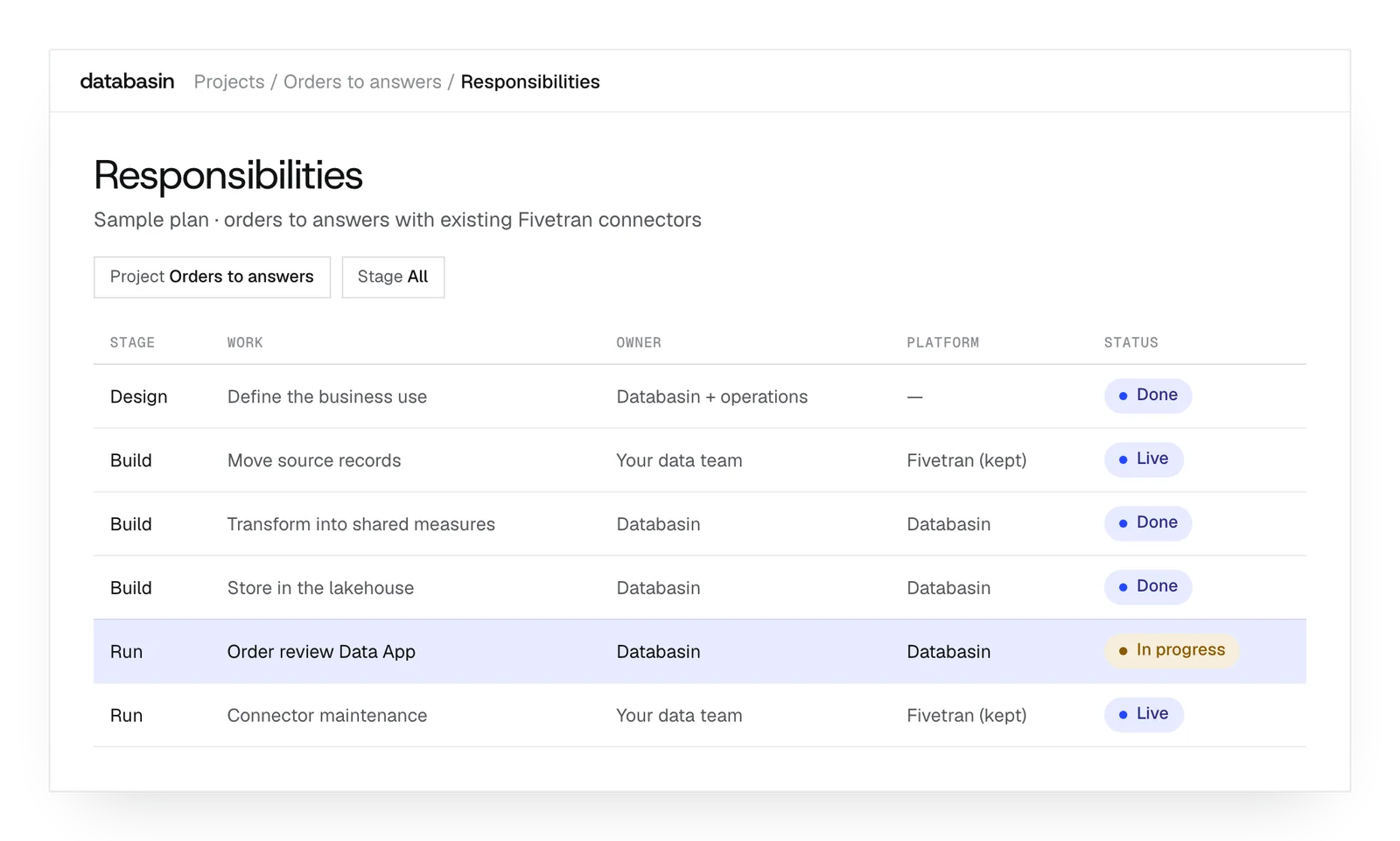
Fivetran with dbt fits teams that want managed data movement and transformations in their chosen destination. Databasin fits when you want a team to deliver the business use case too, including shared definitions, reporting or automated workflows, rollout and support. The comparison covers the complete path from a source update to work people can use.
 databasinvs


Choose by the work needed
Choose Databasin if…
- You want the team preparing the data to build the business application too.
- The outcome needs shared definitions, process changes and user adoption.
- You want ongoing support for the implemented business use case.
Choose Fivetran if…
- You have selected the destination and need managed source movement.
- Your analytics engineers want to develop and maintain dbt models.
- Your team or partner already covers reporting and application delivery.
How far does each approach go?
| Criterion | Databasin | Fivetran with dbt |
|---|---|---|
| Source movement | Connectors and pipelines within the platform | Managed connections load the chosen destination |
| Transformations | SQL, dbt and notebook automation tasks | Hosted dbt and other transformation integrations |
| Business definitions | Team implements the required shared views | Prebuilt models plus your custom definitions |
| Data destination | Included lakehouse or supported existing platform | Your selected warehouse or lake destination |
| Business use | Data Apps, chat and automated workflows | Your chosen BI and application tools |
| Delivery ownership | Design, implementation, adoption and agreed operation | Your team coordinates the complete application |
Preparation
How does source data become usable?
Databasin
We connect the sources and build the calculations that turn their records into business measures. Pipelines move the records; SQL, dbt and notebooks prepare them through automations. Our team arranges the sequence so each measure receives the updates it needs.
- Connect sources through scheduled pipelines
- Run calculations in dependent stages
- Implement definitions for the intended use
Fivetran
Fivetran Transformations runs calculations in the destination after a source sync or on a schedule. Teams can use prebuilt models for selected connectors and hosted dbt for their own models. Other transformation integrations are available for the chosen architecture.
- Load records into the chosen destination
- Use models for selected source schemas
- Run custom transformations through dbt
Business use
How do people use the prepared data?
Databasin
We carry the work into the report or workflow people will use. That can mean building a Data App, providing plain-English analysis through Databasin One or preparing data for an existing BI tool. The choice follows how people need to use the answer.
- Build Data Apps for business users
- Answer questions with supporting SQL
- Retain useful existing reporting tools
Fivetran
Your team chooses the reporting and application tools that consume the prepared data. Fivetran supplies that data within the chosen architecture; internal builders or a partner develop the business experience. This retains the organization's warehouse, modeling and BI choices.
- Keep the chosen data destination
- Develop reports using prepared records
- Select tools for the business experience
Delivery
Who delivers and supports the outcome?
Databasin
We take the use case from design through implementation and introduction to users. Communication and training are part of that delivery. Once it is running, our team can operate the work, provide monthly support or remain available on call.
- Define the business result during design
- Include adoption in the implementation
- Agree support beyond the first delivery
Fivetran
Fivetran operates the data movement service. The wider delivery team coordinates the destination, definitions and applications that depend on it. That team also arranges how people start using the work and who will support later changes.
- Use managed services for source movement
- Assign ownership across the reporting architecture
- Plan adoption with the application team
Keeping Snowflake and existing models
Databasin
Complete the business application around an existing warehouse
Databasin can complete the business application around an existing Snowflake warehouse. We identify the connections, definitions or reporting still needed and build them while retaining useful models. This fits a project where the infrastructure is ready and delivery to users needs further work.
- The warehouse exists but business delivery remains unfinished
- Shared measures need work across source systems
- The project needs implementation and continuing operating help
Fivetran
Feed an established warehouse and analytics engineering process
Fivetran fits when the destination and reporting approach are settled and source synchronization is the remaining gap. It can load Snowflake, leaving the analytics team to develop models and reports through its existing tools. Managed ingestion joins an architecture that already has owners.
- The destination and reporting tools are already selected
- Analytics engineers own the required transformation models
- Managed source synchronization is the main delivery gap
Databasin · How we work · 2026
Fivetran · Transformations · 2026
Fivetran · Snowflake destination · 2026
Databasin · Pipelines and automations · 2026
What happens next
We would like to hear where your team wants to make progress with data and AI. We can discuss a project you have in mind or explore where Databasin could help with the work.
What happens next
Book a demo
Book a conversation about your organization and the work you want to improve. Questions about where to start are welcome.
Explore the opportunity
We show a working example that answers your business questions, then discuss what it would take to deliver it for your team.
Get the first result
After agreeing the first use case, we implement it with your team. We train the people using it and measure how it performs.
FAQ
Is Fivetran an ETL or ELT tool?
Fivetran documents extract, load, transform: records move from the source into the destination before transformations run. Raw records remain there for later model changes. The ELT sequence therefore describes both where the calculations happen and which records are available to them.
Can Databasin run our existing dbt work?
Yes. Automations can run dbt tasks. We examine the destination, models and dependencies before bringing a project into the implementation. Useful business logic can carry forward, while our team adjusts connections or schedules where the selected environment requires it.
Is Fivetran a replacement for Snowflake?
They have different jobs. Fivetran moves records into Snowflake and can coordinate the transformations there. Snowflake stores those records and provides the platform for querying them. The two can therefore be used together in the same reporting architecture.
What happens if a source update fails?
We define how the team will detect a failed update and hold dependent work. Automation logs help trace the run. The operating design also covers incomplete records, because a successful refresh alone does not establish that its data is ready for reporting.
How are sources without a ready-made connector handled?
We can use an API or database connection where a native connector is unavailable. Our team examines the interface and the access the source provides, then implements that route. This establishes which records and history it can deliver and how updates will arrive.
Does loading data automatically preserve business history?
The capture method and the source determine what history is available. We design that treatment around the reporting question. To count a workforce in an earlier period, for example, the model needs the values that applied to workers during that period.
Is Databasin an open-source Fivetran alternative?
Databasin is a commercial platform delivered with an implementation team. It uses open data formats. Those formats describe how data is stored; they do not make Databasin an open-source connector product. Its offer includes delivering the business use case that follows ingestion.
Can the engagement start beyond ingestion?
Yes. If sources are already available, design can focus on the unfinished models, reporting or automated work. Databasin's offer is a first use case live in 90 days. The scope follows the business outcome and the useful work already completed.
Discuss the work after ingestion
Talk with us about the reporting or automated work you want your data to support. We can explore the useful parts of your current architecture and where Databasin's platform and team would contribute to the result.