Databasin vs Domo
Choose Databasin when you want a team to deliver business analysis and automated work on its own platform. Choose Domo when you want to build on its integrated data, BI, application and AI capabilities with your team or partner. Both cover work beyond dashboards. The choice depends on the improvement you need and how you want it delivered.
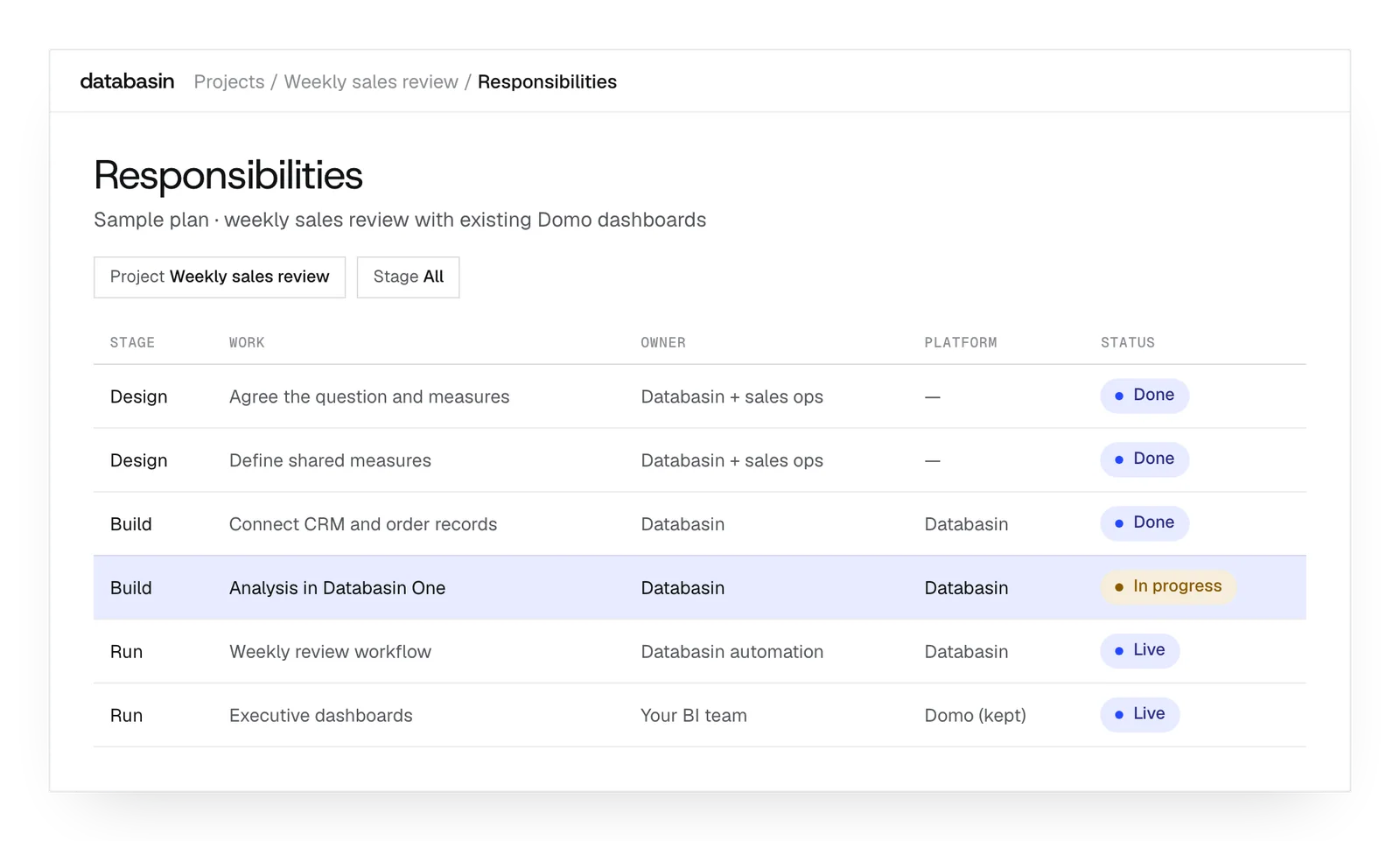
 databasinvs

Choose by delivery approach
Choose Databasin if…
- You want the application builders to handle the data behind it too.
- The improvement needs process design, implementation and help with adoption.
- You want an operating arrangement that continues after the first delivery.
Choose Domo if…
- You want to develop applications within an integrated analytics environment.
- Existing Domo data flows and reports already support useful work.
- Your internal team or partner can lead implementation and adoption.
What comes with each approach?
| Criterion | Databasin | Domo |
|---|---|---|
| Main offer | Delivered business improvement using its own platform | Integrated data, analytics, apps and AI platform |
| Data preparation | Team implements sources and shared business views | Connectors and transformation tools for builders |
| User experience | Data Apps and plain-English analysis | Dashboards, applications and AI experiences |
| Automated work | Team implements scheduled workflows around the outcome | Workflow and automation capabilities for applications |
| Rollout | Communication and training included in delivery | Your implementation arrangement defines rollout responsibilities |
| Continuing work | Operation, monthly support or on-call help | Internal or partner-led application ownership |
Definitions
Who turns questions into shared measures?
Databasin
We start with the questions people need to answer and agree what the measures mean. Our team then connects the records and builds those definitions into reusable business views. The application draws on that prepared data when people ask for an answer.
- Define measures with business owners
- Connect records across relevant sources
- Build reusable views for analysis
Domo
Builders can use Domo to connect sources and transform their records into shared datasets. They then reuse those datasets in reports and applications. Preparation and analysis sit within the same platform, with the builders defining the measures needed by the business.
- Connect sources to the analytics environment
- Prepare records through transformation tools
- Reuse datasets across business applications
Application
How does analysis become usable work?
Databasin
We build the Data App, analysis or workflow that the business needs, then help people put it to use. Communication and training are part of delivery. A completed application needs to fit the daily work of the people receiving it.
- Build applications around business questions
- Connect analysis with recurring workflows
- Include rollout and user training
Domo
Domo gives builders BI, application, automation and AI capabilities in one environment. They can use them for an interactive report or an application that supports a later step in the business process. The intended experience determines which capabilities they combine.
- Develop reports and analytical applications
- Use AI within analytical experiences
- Add workflows to business applications
Operation
Who keeps the application useful?
Databasin
The people who deliver the application can stay involved after launch. We can operate it, provide monthly support or help on call. The engagement sets out that responsibility and the improvements our team will make as the business changes.
- Choose the required operating arrangement
- Support the implemented data application
- Develop further improvements when needed
Domo
Applications run in Domo, while an internal team or partner maintains their logic. That team handles changes to the surrounding business process too. The implementation and service arrangements establish how this continuing work is supported.
- Keep owners for application behavior
- Update definitions as requirements change
- Support users of the analytical work
Extending or replacing existing analytics
Databasin
Deliver a business application with its own team
Databasin fits an application that needs someone to carry it from source work into daily use. We can settle inconsistent measures, automate repeated reporting tasks and build the way people investigate the result. Our team then helps introduce that completed work to its users.
- Data preparation and application work need coordinated delivery
- The project needs help changing everyday reporting
- Ongoing support is part of the intended arrangement
Domo
Extend an established environment with your current builders
Domo fits when its datasets and applications are already part of everyday work. If the current builders can deliver the next application, they can extend that environment. People keep familiar interfaces, and useful preparation work carries into the next project.
- Existing datasets support the next business question
- People already use the current analytical applications
- The delivery team can extend and support them
What happens next
We would like to hear where your team wants to make progress with data and AI. We can discuss a project you have in mind or explore where Databasin could help with the work.
What happens next
Book a demo
Book a conversation about your organization and the work you want to improve. Questions about where to start are welcome.
Explore the opportunity
We show a working example that answers your business questions, then discuss what it would take to deliver it for your team.
Get the first result
After agreeing the first use case, we implement it with your team. We train the people using it and measure how it performs.
FAQ
What happens to Domo calculations during a move?
We trace how the calculation uses joins, filters and dates, then build that logic into the new model. Comparing its results with Domo checks more than the visible formula. It helps establish that the rebuilt measure retains the meaning people expect.
Do refresh schedules need to stay the same?
We set the schedule around when people need the answer and when each source is available. That may preserve the existing refresh times. Where a later task depends on an earlier update, we also arrange the sequence so it receives the data it needs.
How can someone inspect a Databasin answer?
The answer includes its SQL and source tables. A reviewer can see which periods, segments and filters the calculation used, then compare them with the intended definition. The same evidence is available when a follow-up question changes the answer.
Can Databasin work with the warehouse we already use?
Yes. We can design the application around an existing Snowflake, Databricks or Fabric environment. Our team establishes how it connects and which permissions it uses. A change to the application can therefore leave useful warehouse work in place.
What if our analytics serves external customers?
We include the customer audience in the design from the start. Our team establishes how customers sign in, which records they may see and how they receive the application. Sharing measures with an internal report does not by itself settle those delivery and access choices.
Can analytical chat change source records?
Production-source tools used by analytical agents are read-only. Each run inherits connection permissions and has limits. We implement any required write or external action as a separate authorized task, with permission for the specific operation it must perform.
Can existing Power BI measures inform the new application?
Yes. Databasin One can use an exported Power BI semantic model to map tables and translate relevant DAX into SQL. We review the table mappings and expressions during implementation. These definitions come from Power BI; Domo calculations require their own rebuild.
How is the first analytical application selected?
Design starts with a business problem and the improvement it could produce. Our team examines the process, expected return and source dependencies, then defines a first use case. The offer includes getting that use case live in 90 days, with adoption included.
Discuss your analytics plans
Talk with us about how people use analytics today and what you want them to do next. We can explore the application, the data behind it and where our team could help deliver the improvement.