Data and AI built at WashU
We help organizations turn connected data into answers, shared applications and recurring workflows. Databasin was built at Washington University School of Medicine and runs there today. Our principal-level team brings that production experience to the sources, processes and questions your organization needs to address.





Databasin brought financial data from more than 20 systems together at WashU Medicine.
Experience from an academic medical center
Databasin grew from the work of preparing data for people inside Washington University School of Medicine. It was co-created at the Institute for Informatics, Data Science & Biostatistics to address the institution's Epic data needs. The platform entered production there in 2022.
That work involved complex source records, local definitions and people who needed to use the result in research, finance and operations. Today, our team applies that experience when implementing Databasin for other organizations, from the source connections through the applications people use.
Experience applied to your work
Complex source data
Connect the source records your departments need and prepare them for research, finance and operating questions.
Shared business definitions
Work through each measure with its owner, then make the calculation available to questions and reports.
Useful applications
Build applications and repeated workflows that let teams use the records in their reviews and decisions.
What can people do with it?
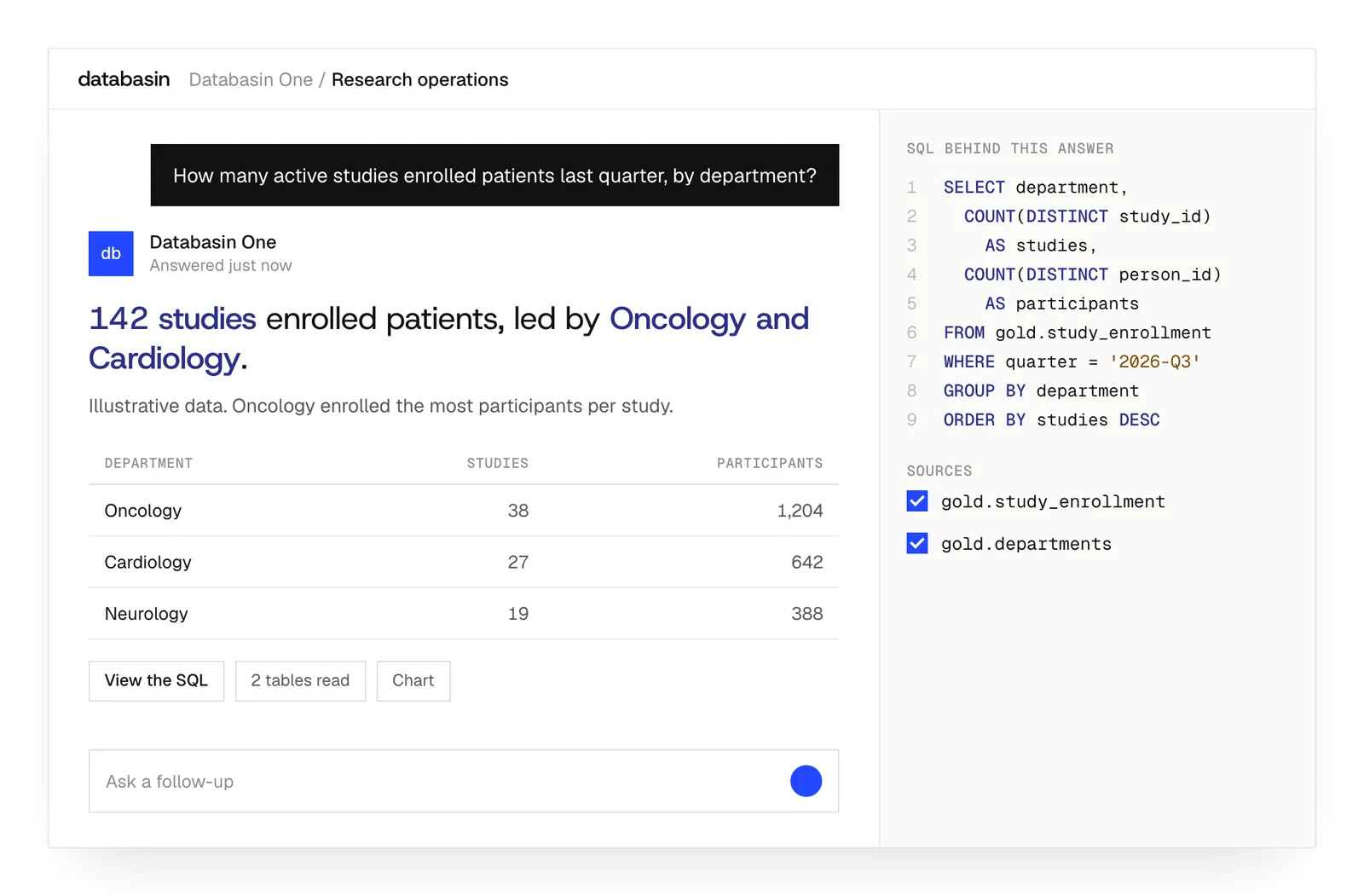
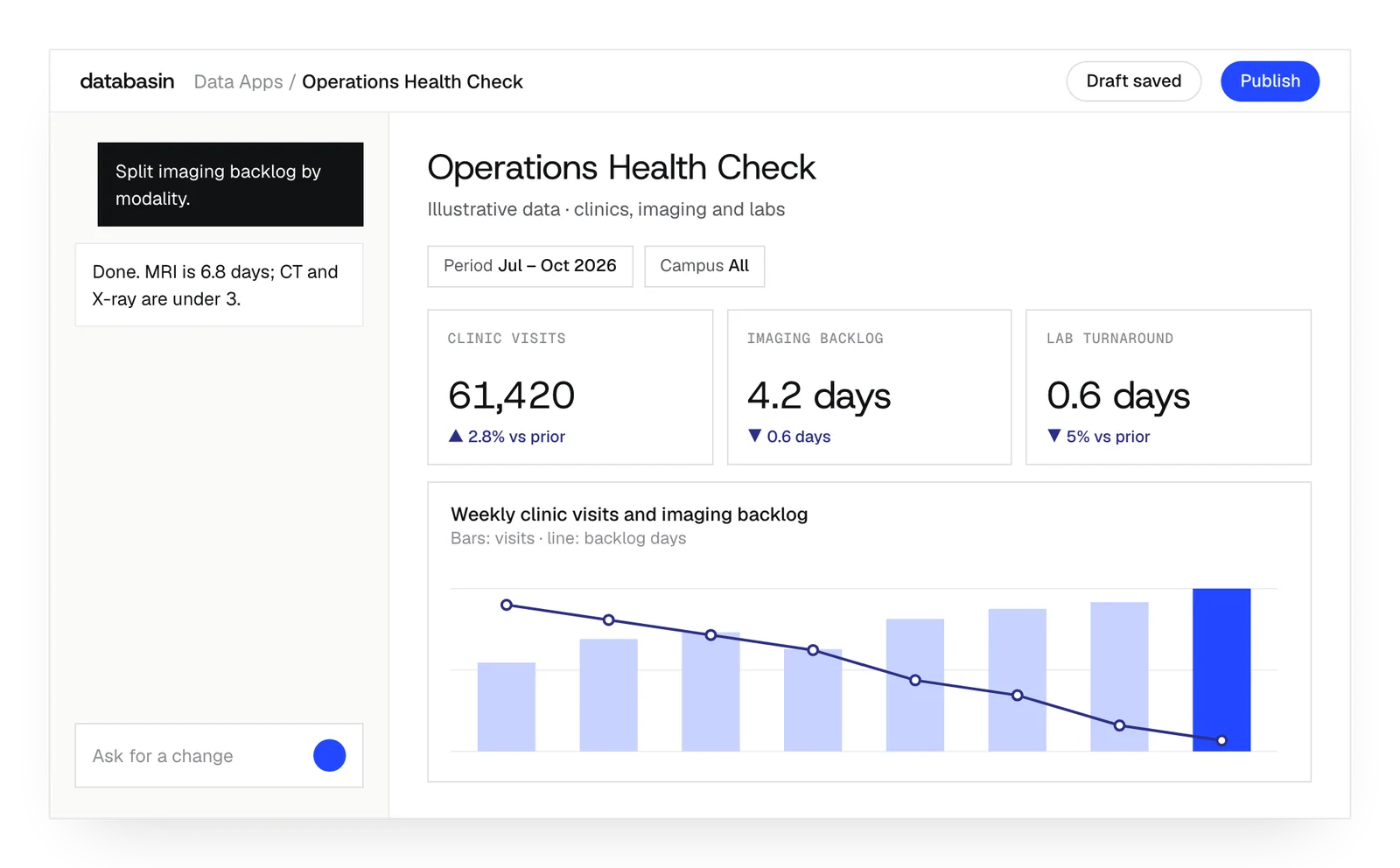
Databasin One lets a person ask a question and inspect the explanation with its SQL. A useful set of views can become a shared application. Colleagues explore measures in Data Apps, while analysts use BI tools or notebooks to examine the prepared data. Those interfaces can use the same underlying definitions.
Delivery around your organization
We define the result your organization wants, then build around its sources and working practices. Its own business definitions determine the measures. Communication, training and success measurement help the team put the resulting application into use.
Databasin can run in your Azure environment or with an existing data platform. After launch, we can operate the solution, provide monthly support hours or stay on call. The experience gained in production informs this work; the implementation follows the needs of your organization.
What happens next
We would like to hear where your team wants to make progress with data and AI. We can discuss a project you have in mind or explore where Databasin could help with the work.
What happens next
Book a demo
Book a conversation about your organization and the work you want to improve. Questions about where to start are welcome.
Explore the opportunity
We show a working example that answers your business questions, then discuss what it would take to deliver it for your team.
Get the first result
After agreeing the first use case, we implement it with your team. We train the people using it and measure how it performs.
FAQ
Is Databasin limited to academic medical centers?
No. Databasin runs in healthcare, research, higher education, finance, insurance, real estate and consumer packaged goods. We implement the platform around each organization's business processes and the records needed to support them.
Can the experience apply to a mid-sized operating company?
Yes. Our current work focuses on mid-market organizations that need hands-on help with data and AI. We begin with a business improvement and use the platform capabilities relevant to that work.
Do we have to use Epic to benefit from Databasin?
No. Epic was part of the platform's origin, but Databasin connects other business systems, databases and files. Workday, NetSuite and Salesforce are among the sources available for other kinds of analysis.
Will another institution's clinical definitions be imposed on ours?
No. The implementation uses the definitions and mappings appropriate to your institution. Existing material helps us begin, while the final calculation reflects the local question and the process that produced its records.
Does the platform require proprietary storage?
Databasin uses open table formats, including Apache Iceberg, for synced records. Compatible engines can read the data. During design, we establish how the required applications, reports and notebooks will connect and query it.
Can our security team review the deployment before implementation?
Yes. We can work through the architecture with your technical and security owners. The discussion includes storage, identity, source access and model endpoints. Databasin Private can use your Azure tenant, storage, keys and network.
What industry recognition has Databasin received?
Microsoft and Databricks featured Databasin at HIMSS in 2023, 2024 and 2025. Databasin is a partner of both.
Can analysts continue using their existing tools?
Yes. We establish the supported connections for the BI tools, SQL and notebooks you intend to keep. Analysts can use them on governed data alongside the people working in Databasin One and Data Apps.
How is access handled for regulated information?
We configure permissions for the data and applications with the relevant technical and security owners. Databasin is HIPAA-ready, with a BAA available. That design establishes access for the regulated information used in the work.
Can we discuss the architecture with the implementation team?
Yes. We can examine the proposed analysis, source systems and current environment together. Those discussions can help define the project while it is still taking shape; a completed architecture is not needed to start talking.
Talk about your data work
We can talk about the questions your organization needs to answer and what is preventing people from using the data today. Our team can explain how Databasin would fit the work and systems you already have.